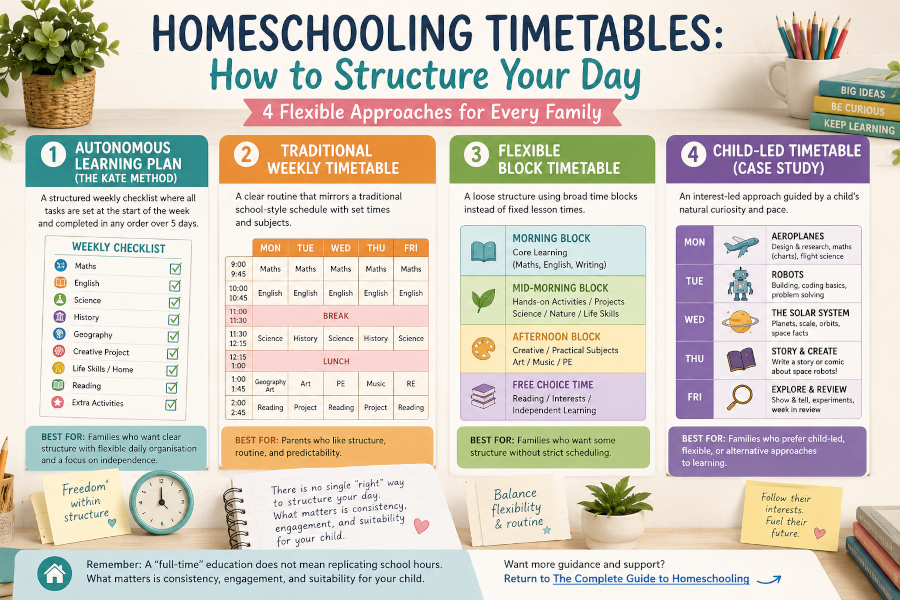
There is no single “right” way to structure your day. This article discusses 4 different ways that you can structure your week of learning. These examples show different approaches you might adapt to suit your child and family.
Remember:
A “full-time” education does not mean replicating school hours.
What matters is consistency, engagement, and suitability for your child.
Example 1: Autonomous Learning Plan (The Kate Method)
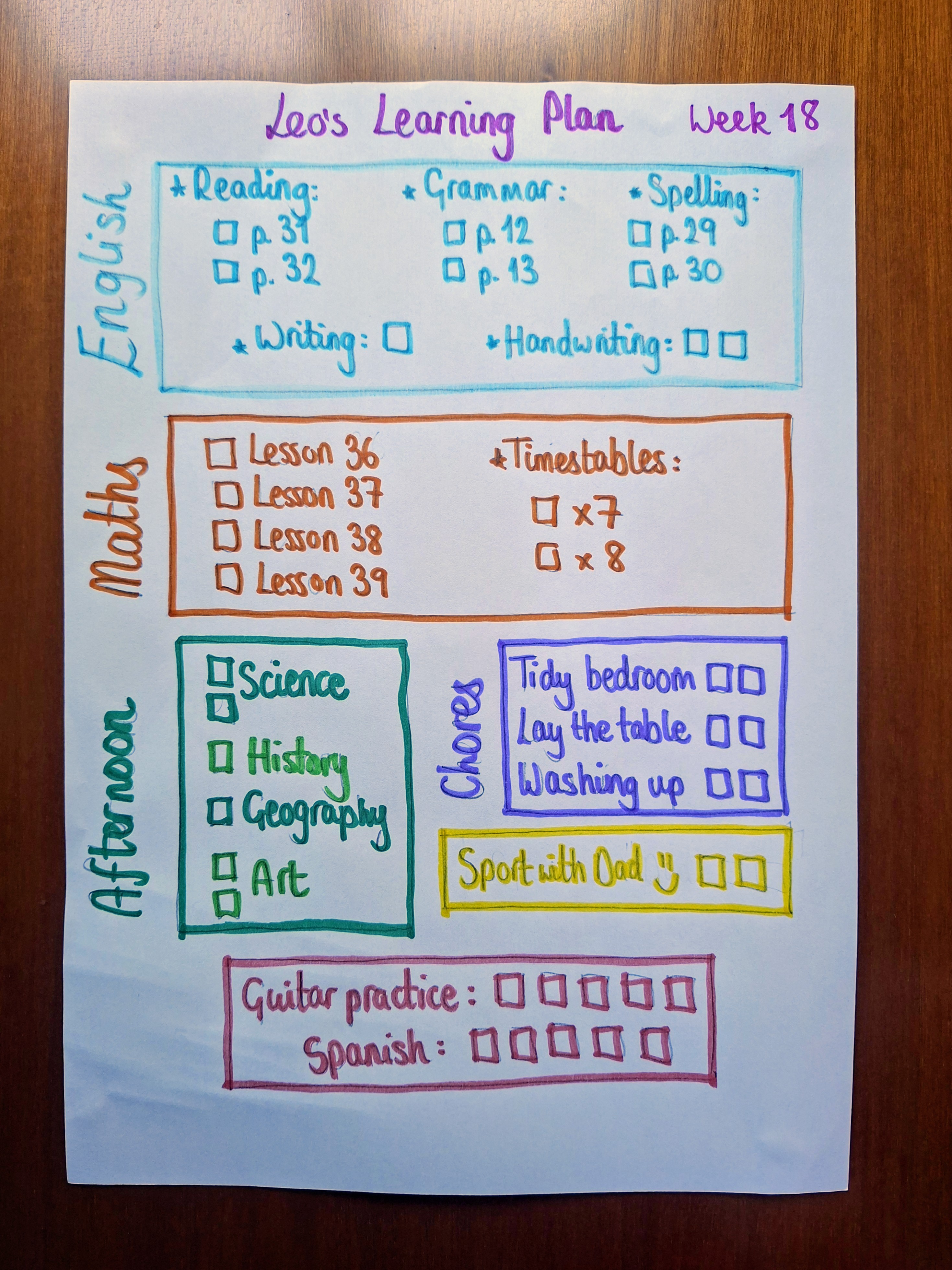
This is the method that we have come up with (through a lot of trial and error along the way, I might add!) We like this method because it clearly maps out all of our structured learning, along with a range of other learning or household activities that they can get done.
We like how it helps our children to build their autonomy and independence by deciding when and how to complete all their tasks. We use extrinsic rewards once all the tasks are finished, such as they get to watch a film or get an hour to play a video game.
Description: A structured weekly checklist where all tasks are set at the start of the week and completed in any order over 5 days.
Notes: Core learning is broken into subject-based tasks, giving children flexibility in how they organise their time while ensuring everything is completed by the end of the week.
Best for: Families who want clear structure with flexible daily organisation and a focus on independence.
Pros:
-
Clear weekly expectations
-
Ensures consistent coverage of core subjects
-
Builds independence and time-management skills
-
Easy for parents to track progress
Cons:
-
Requires children to manage their own workload
-
Needs planning to avoid end-of-week pressure
-
May rely on external motivation for completion
We find that the easiest way to make this is to simply write it on a piece of paper using colourful felt-tip pens and blu-tack it to the wall! If you want a digital version, here is an editable freebie of the autonomous learning plan:
Example 2: Traditional weekly timetable
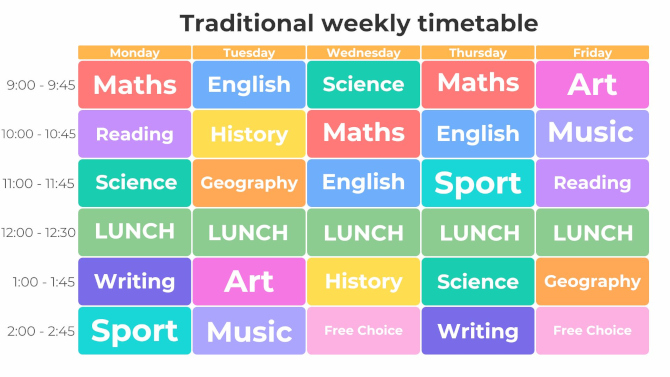
Description: A clear routine that mirrors a traditional school-style schedule with set times and subjects.
Notes: Specific timings and days are allocated to different areas of learning.
Best for: parents who like structure, routine, and predictability.
Pros:
-
Clear structure and easy to follow
-
Helps parents feel organised and in control
-
Familiar format for children transitioning from school
-
Makes it easier to ensure all core subjects are covered
Cons:
-
Can feel rigid or restrictive over time
-
Less room for spontaneous or interest-led learning
-
May feel too “school-like” for families seeking flexibility
-
Harder to adapt when life changes day to day
Example 3: Flexible block timetable
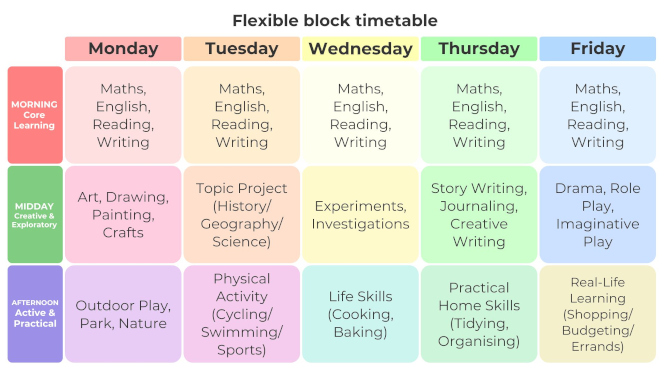
Description: A loose structure using broad time blocks instead of fixed lesson times.
Notes: This ensures that you still cover traditional curriculum basics but with more flexibility in how and when they happen.
Best for: Families who want some structure without strict scheduling.
Pros:
-
Balanced mix of structure and flexibility
-
Easier to adapt to daily life and energy levels
-
Still ensures coverage of core learning areas
-
Reduces pressure around exact timing
Cons:
-
Requires some parental confidence in planning
-
Can drift without gentle structure or routine checks
-
Less predictable for children who prefer fixed schedules
-
May need occasional adjustment to stay consistent
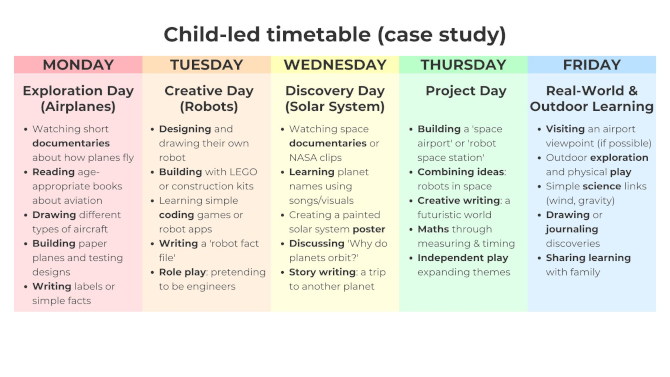
Example 4: Child-led timetable (case study)
Description: An interest-led approach guided by a child’s natural curiosity and pace. A weekly example is provided using interests such as aeroplanes, robots, and the solar system.
Notes: Learning is woven through interests rather than separated into subjects, making structure more fluid and evolving. Now, while it is true that it seems a little counterintuitive to create a timetable for a week of truly child-led learning, this is a case study example to should you how you can guide your child’s interest into a truly enriching learning journey.
Best for: Families who prefer child-led, flexible, or alternative approaches to learning.
Pros:
-
Highly engaging and motivating for children
-
Encourages deep, meaningful learning through interests
-
Naturally integrates multiple subjects at once
-
Flexible and adaptable to changing curiosity
Cons:
-
Can feel less structured for parents new to home education
-
Harder to “see” traditional subject coverage at a glance
-
Requires trust in the learning process
-
May need gentle guidance to ensure balanced coverage over time
I hope that you have enjoyed exploring these different ways to structure a week of home education. Hopefully, it gives you reassurance and confidence as you begin or continue your home education journey.
Related reading
If you’d like to explore more guidance, practical ideas, and step-by-step support, you can return to The Complete Guide to Homeschooling here: The Complete Guide to Homeschooling